How do you trade XRP?
To trade XRP, open an account with a multi-asset broker such as NordFX, deposit funds, and trade the XRPUSD pair in MetaTrader 4 or 5. Choose your volume, set a Stop Loss and Take Profit, then open a Buy or Sell position — you can profit from both rising and falling prices.
XRP has spent more than a decade in the top ten cryptocurrencies by market capitalization, and 2026 may be the most interesting year in its history to trade it. The SEC's long-running case against Ripple formally closed in August 2025, spot XRP exchange-traded funds (ETFs) launched in late 2025 with record-breaking inflows, and in March 2026 U.S. regulators jointly classified XRP as a commodity. Regulatory clarity, deep liquidity and persistent volatility — the three ingredients every active trader looks for — are now all present in the XRP market.
This guide explains exactly how to trade XRP, from choosing between spot, CFD, futures and ETF exposure, to opening your first XRPUSD position on NordFX, applying proven trading strategies, reading XRP charts, and protecting your capital with professional risk management. Whether you have never placed a crypto trade or you are an experienced trader adding digital assets to your watchlist, by the end of this article you will have a complete, actionable framework for trading XRP.
Important: On NordFX, XRP is traded as the XRPUSD instrument — price-based trading against the US dollar, not on-chain XRP that you transfer to a private wallet. This means you can open both buy (long) and sell (short) positions and use margin, depending on your account type, and you don't need a crypto wallet to trade it as CFD.
What Is XRP and Why Do Traders Choose It?
Before learning how to trade XRP, it helps to understand what you are actually trading.
XRP is the native digital asset of the XRP Ledger (XRPL), an open-source, permissionless blockchain launched in 2012 by developers David Schwartz, Jed McCaleb and Arthur Britto. The ledger was designed for one job above all others: moving value across borders quickly and cheaply. Transactions on the XRPL settle in 3–5 seconds, the network handles up to 1,500 transactions per second, and the average fee is around $0.0002 — a fraction of a cent.
Ripple, the San Francisco fintech company most closely associated with the token, builds payment infrastructure on top of the XRPL. Its network is used by financial institutions such as Santander, Standard Chartered and Travelex Bank to settle cross-border payments, and the company raised $500 million in November 2025 at a valuation of roughly $40 billion. It is important to keep the distinction clear: Ripple is the company, XRP is the independent digital asset, and the XRP Ledger is the blockchain where transactions are recorded.
Why XRP appeals to active traders
Several characteristics make XRP one of the most actively traded altcoins in the world:
- High liquidity. XRP routinely posts billions of dollars in daily trading volume across major venues — recent 24-hour volume figures have ranged between roughly $1.8 billion and $3.2 billion in 2026. Tight spreads and deep order books mean traders can enter and exit positions with minimal slippage.
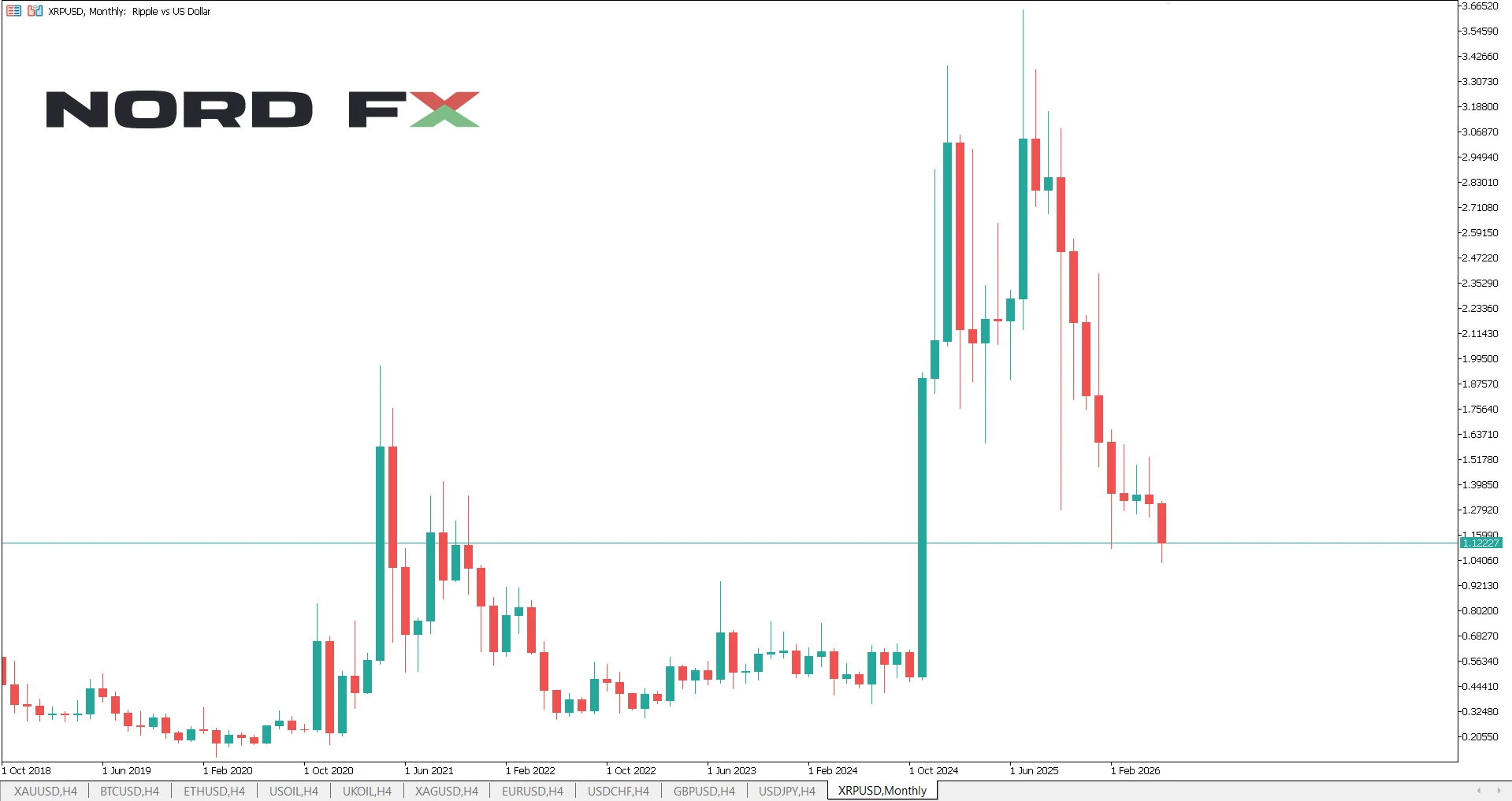
- Pronounced volatility. XRP traded as high as $3.66 in mid-2025 and as low as ~$1.05 in June 2026. Moves of 5–10% in a single session are not unusual. Volatility is risk, but for a disciplined trader it is also opportunity — in both directions.
- Regulatory clarity. With the SEC case resolved, retail XRP transactions ruled not to be securities, and a joint SEC–CFTC commodity classification in March 2026, XRP carries less legal uncertainty than most large-cap altcoins.
- News-driven price action. ETF flow data, Ripple partnership announcements, escrow unlocks and U.S. legislation (notably the CLARITY Act) create frequent, tradeable catalysts.
- A 24/7 market. Unlike stocks or forex, XRP trades around the clock, every day of the year, on spot markets — and nearly around the clock via derivatives.
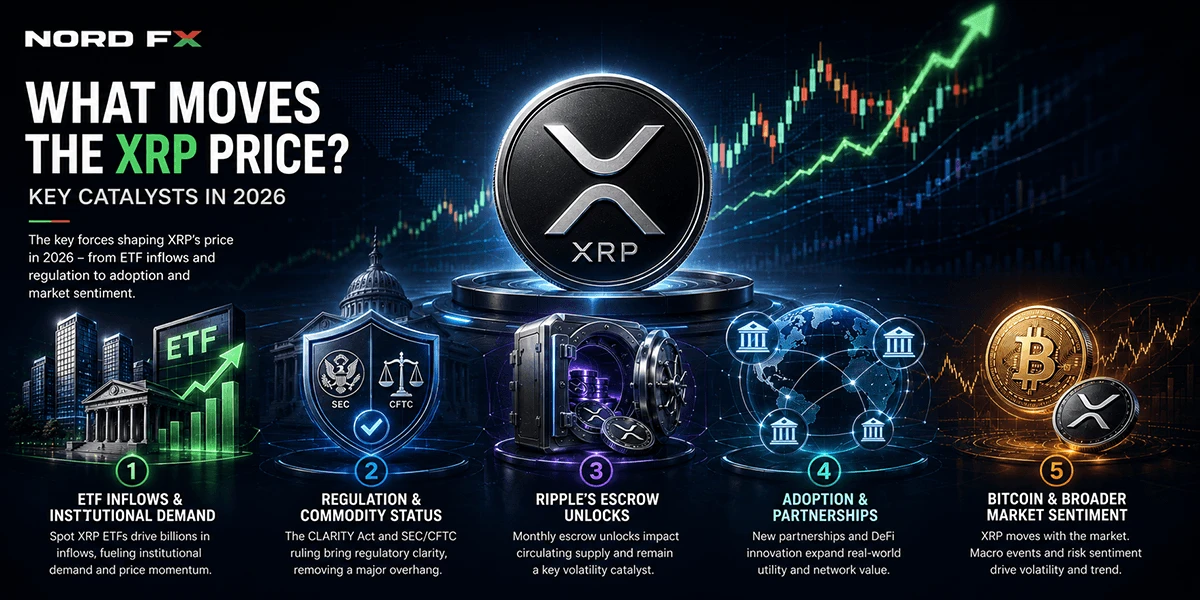
What Moves the XRP Price? Key Catalysts in 2026
Successful XRP trading starts with understanding the forces behind the chart. These are the dominant price drivers traders monitor:
1. ETF inflows and institutional demand
Spot XRP ETFs launched in late 2025; Canary Capital's fund attracted $250 million on its first day — the largest crypto ETF debut of the year. By mid-2026, the funds collectively held well over $2.5 billion in assets, and weekly inflow/outflow reports now move the XRP price the way ETF flows move Bitcoin. Standard Chartered has modeled an $8 bull case for XRP if roughly $10 billion in ETF inflows materialize, against a $2.80 base case.
2. Regulation: the CLARITY Act and commodity status
The CLARITY Act, which establishes explicit legal categories for digital assets in the United States, has become arguably the single largest fundamental driver of XRP sentiment. The SEC and CFTC jointly classified XRP as a commodity in March 2026, removing a long-standing overhang. Headlines about implementation, amendments or enforcement still trigger sharp intraday moves.
3. Ripple's escrow unlocks
Ripple holds a large share of the total 100 billion XRP supply in escrow and releases up to 1 billion XRP monthly. Most of each unlock is typically re-escrowed, but traders watch these events closely because they affect circulating supply expectations. Scheduled unlocks are a recurring, calendar-based volatility catalyst.
4. Adoption and partnership news
Ripple announced three new banking partnerships in Q2 2026, including a Southeast Asian remittance corridor processing over $12 billion annually. Its 2026 roadmap shifts the XRPL toward institutional DeFi — native lending (XLS-66), tokenized collateral and cross-chain interoperability — turning XRP from a pure bridge asset into potential yield-bearing infrastructure. Each milestone is a tradeable event.
5. Bitcoin and broader market sentiment
Like all altcoins, XRP remains correlated with Bitcoin. Macro events — Federal Reserve decisions, risk-on/risk-off shifts, liquidation cascades like the $19 billion event of October 2025 — move the entire crypto market, and XRP usually moves with it, often with higher beta.
XRP Price History: What Every Trader Should Know
Context is edge. Knowing how XRP has behaved in past cycles helps you recognize what kind of market you are trading today.
2017–2018: the first mania. XRP rode the ICO-era bull market to an all-time high of $3.84 in January 2018, then lost more than 90% of its value in the bear market that followed. Lesson: XRP is capable of parabolic rallies — and equally violent retracements.
2020–2023: the SEC overhang. The SEC's December 2020 lawsuit against Ripple triggered exchange delistings and pushed XRP as low as $0.15. The partial court victory of July 2023 — ruling that programmatic exchange sales were not securities — sent XRP up 75% in a single day. Lesson: legal and regulatory headlines are XRP's most powerful single-day catalysts, in both directions.
2024–2025: the recovery cycle. From a low of $0.38 in July 2024, XRP gained nearly 600% in the months that followed, fueled by post-election crypto optimism, progress in the SEC case, and ETF anticipation. It peaked at $3.66 in July 2025 — a seven-year high — shortly before the case formally closed in August 2025 with a $50 million settlement.
Late 2025–2026: the extended correction. The October 2025 liquidation cascade (roughly $19 billion across crypto markets) and broader risk-off sentiment started a persistent downtrend: XRP broke $1.12 in February 2026 and, after a spring consolidation around $1.30–$1.45, slid to a low near $1.047 in early June 2026 — a roughly 70% retracement of the entire 2024–25 rally. Lesson: even with strong fundamentals, XRP remains a high-beta asset that follows the broader crypto cycle, and downtrends can run far longer than fundamentals seem to justify.
For traders, this history translates into three working assumptions: expect volatility far beyond what forex or equities deliver; treat regulatory and ETF headlines as first-class trading events; and never assume a trend — up or down — will persist without confirmation.
4 Ways to Trade XRP: Spot, CFDs, Futures and ETFs
There is no single "right" way to trade XRP. The best vehicle depends on your goals, time horizon, jurisdiction and risk tolerance.
Spot trading: owning the actual coins
Spot trading means buying real XRP on a crypto exchange and holding it in a wallet. You profit if the price rises and you sell higher than you bought.
Best for: longer-term positions, traders who want actual ownership, users who plan to use XRP on the ledger.
Pros: full ownership; no overnight financing costs; you can transfer coins to private wallets; no expiry dates.
Cons: profit only when price rises (unless the venue offers margin shorting); responsibility for storage and security; withdrawal and custody considerations.
CFD trading: speculating on price without ownership
A contract for difference (CFD) is a derivative that tracks the XRP price. You never own the coins — you open a leveraged contract with a broker and profit (or lose) from the difference between your entry and exit price. CFDs make it equally simple to go long or short, which matters in a market that fell from $3.66 to $1.12 in seven months.
Best for: short-term traders, forex traders who want crypto exposure on a familiar platform (such as MetaTrader 4/5, used at NordFX), anyone who wants to trade falling prices as easily as rising ones — particularly relevant in a market that fell from $3.66 to $1.05.
Pros: trade long and short with one click; leverage amplifies buying power; no wallets, keys or custody risk; trade XRP alongside fiat currencies, stocks, gold and indices in one account; regulated broker environment.
Cons: leverage amplifies losses as well as gains; overnight swap fees on positions held for days; you cannot withdraw coins because you never own them.
Futures: dated derivatives for advanced traders
XRP futures — including CME-listed contracts aimed at institutions — let traders speculate with leverage or hedge existing holdings. Perpetual futures ("perps") on crypto exchanges work similarly but never expire, using funding rates to track spot prices.
Best for: experienced derivatives traders, hedgers, basis traders.
ETFs: passive exposure through a brokerage account
Spot XRP ETFs let investors gain exposure through a traditional stock brokerage — no wallets, no crypto exchange account. ETFs trade only during stock market hours and charge management fees, so they suit investors more than active traders.
Comparison table
Feature | Spot | CFD | Futures | ETF |
Own the underlying XRP | Yes | No | No | No (fund holds it) |
Go short easily | Limited | Yes | Yes | No |
Leverage available | Rarely | Yes | Yes | No |
Trading hours | 24/7 | ~24/5–24/7 | Venue hours | Stock market hours |
Custody/wallet needed | Yes | No | No | No |
Typical user | Investor/holder | Active trader | Pro trader | Passive investor |
How to Trade XRP on NordFX: Step-by-Step
This is the practical core of the guide. On NordFX, XRP is traded as the XRPUSD pair via MetaTrader 4 or MetaTrader 5. Follow these steps to go from zero to a live, properly managed position.
Step 1: Open a Trading Account
To start trading XRP:
- Visit the official NordFX website.
- Click "Open an Account" button in the header of the site.
- Fill in your name, email, phone number, and country.
Once your email is confirmed, you can log in to your Personal Area. Minimum deposit requirements depend on the account type you choose — compare MT4 and MT5 Pro and Zero accounts before deciding. Choose your account and open it.
Step 2: Deposit Funds
Before you can trade XRP, you need to fund your account:
- Log in to your Personal Area.
- Go to the "Deposit" section.
- Select a payment method (bank card, bank transfer, e-wallet, or cryptocurrency, depending on availability).
- Enter the deposit amount.
- Confirm the transaction.
Tip: Always check deposit fees, processing time, and minimum funding thresholds before transferring money. Start with an amount you can genuinely afford to lose.
Step 3: Install and Log In to MT4 or MT5
XRP trading on NordFX is done via trading platforms such as MetaTrader 4 (MT4) or MetaTrader 5 (MT5):
- Download MT4 or MT5 from the broker's website.
- Install the platform on your device.
- Log in using your trading account number and password.
- Open the "Market Watch" window.
- Locate the XRPUSD trading pair.
If you don't see XRPUSD, right-click inside Market Watch and select "Show All."
Step 4: Analyze the Market Before You Click Buy or Sell
Never open a position on impulse. At a minimum:
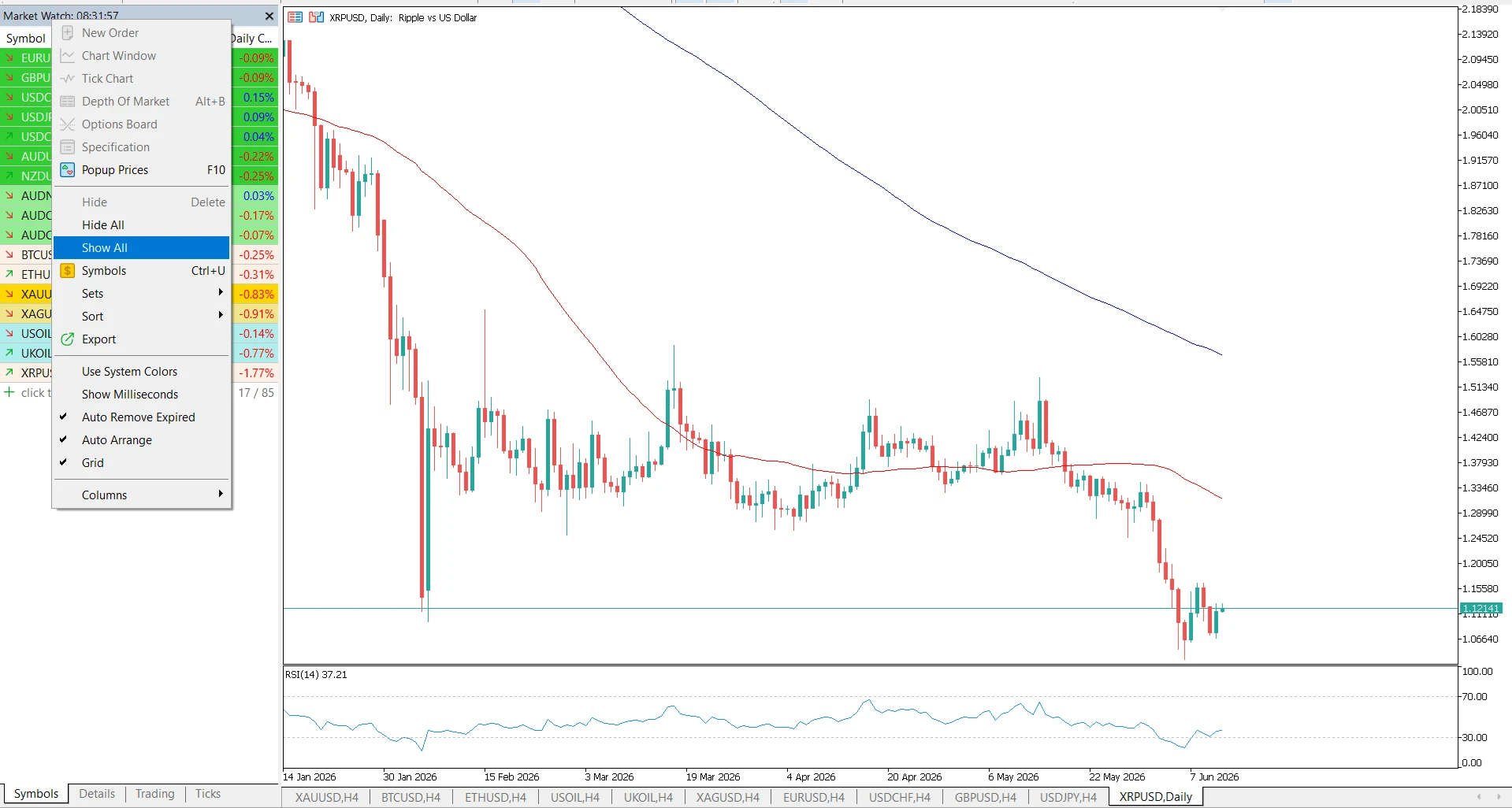
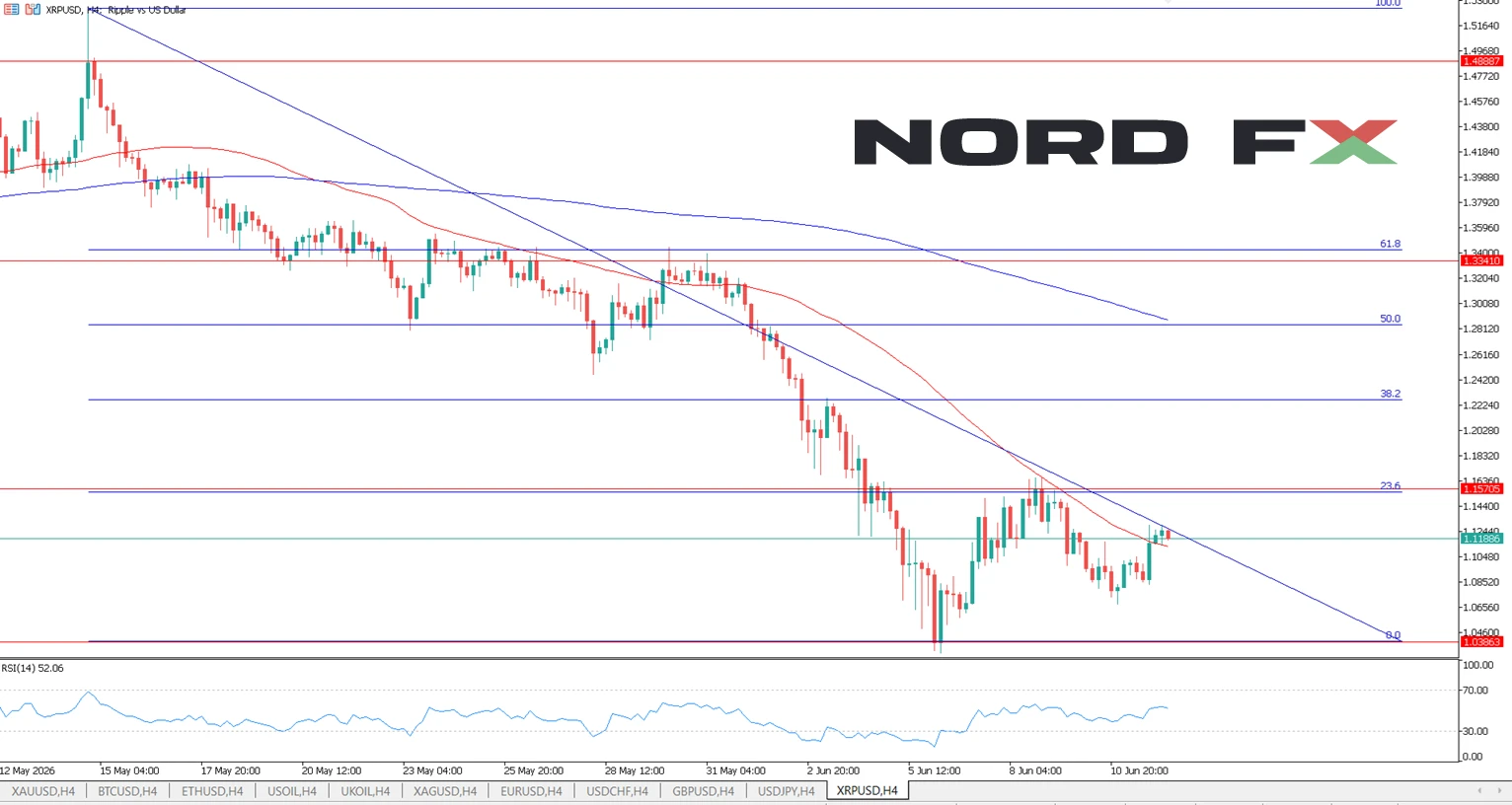
- Check the higher-timeframe trend (daily and 4-hour charts). As of mid-June 2026, XRPUSD trades near $1.12, below its falling 50- and 200-day moving averages — a defined downtrend.
- Mark the key support and resistance levels (currently: support at the June low of $1.047 and the psychological $1.00; resistance at $1.154, $1.218 and $1.282 — the 23.6%, 38.2% and 50% Fibonacci retracements of the May–June decline).
- Check the economic and crypto calendar for catalysts — ETF flow reports, escrow unlock dates, U.S. regulatory votes.
- Confirm with at least one indicator (RSI, moving averages or volume — covered below).
Step 5: Open an XRP Trade (XRPUSD)
To place your first order in MT4/MT5:
- Click on XRPUSD in Market Watch.
- Select "New Order" (or press F9).
- Choose your trade volume (lot size).
- Set your Stop Loss and Take Profit levels.
- Click "Buy" to open a long position — or "Sell" if you expect the price to fall.
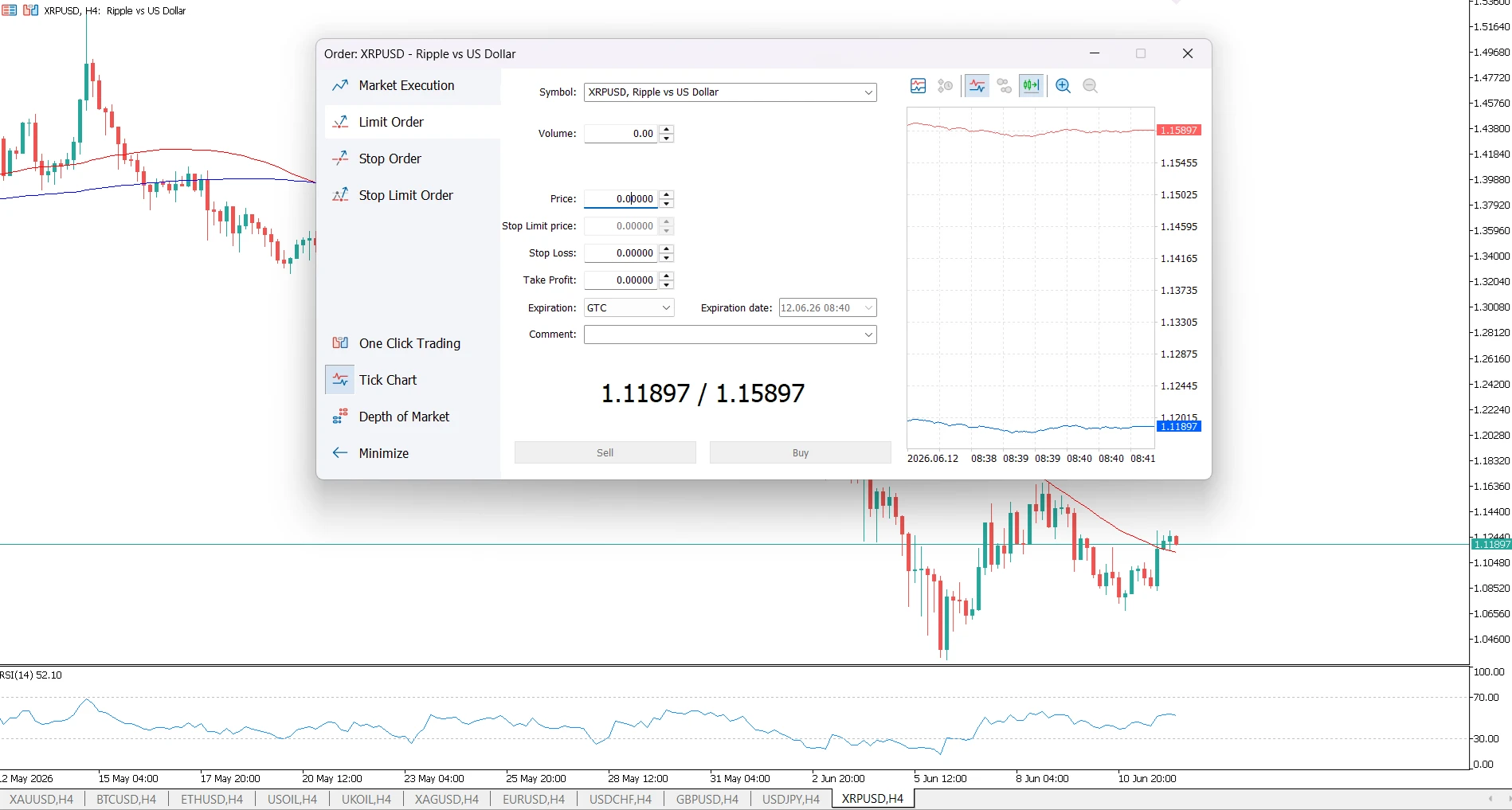
Understand the three core order types before trading real money: a market order executes immediately at the current price; a pending (limit) order executes only at your chosen price or better, letting you buy dips or sell rallies without watching the screen; and a stop order triggers when price crosses a level — the building block of every stop-loss.
A disciplined first trade includes three decisions at once: entry price, stop-loss price and take-profit target. If you cannot state all three before entering, you are not ready to enter. Your open trade will appear in the "Trade" tab of the terminal.
Step 6: Manage the Open Position
Once in a trade, your job is management, not hope:
- Move your stop-loss to breakeven once the trade moves meaningfully in your favor.
- Consider taking partial profits at the first target.
- Never widen a stop-loss to "give the trade room." That is how small losses become account-threatening ones.
- For positions held overnight, account for swap fees in your profit target.
Step 7: Withdraw Profits
When you close a profitable position, the result is credited to your account balance in your account currency. Go to the "Withdrawal" section of your Personal Area and choose from the same range of methods available for deposits. Because XRPUSD on NordFX is price-based trading, there are no wallets or on-chain transfers to manage — and no custody risk.
Leverage is available on XRPUSD depending on account type, client category and regional regulations — always check the instrument specification inside MT4/MT5 for current limits, and remember that leverage amplifies losses as much as gains.
6 Proven XRP Trading Strategies
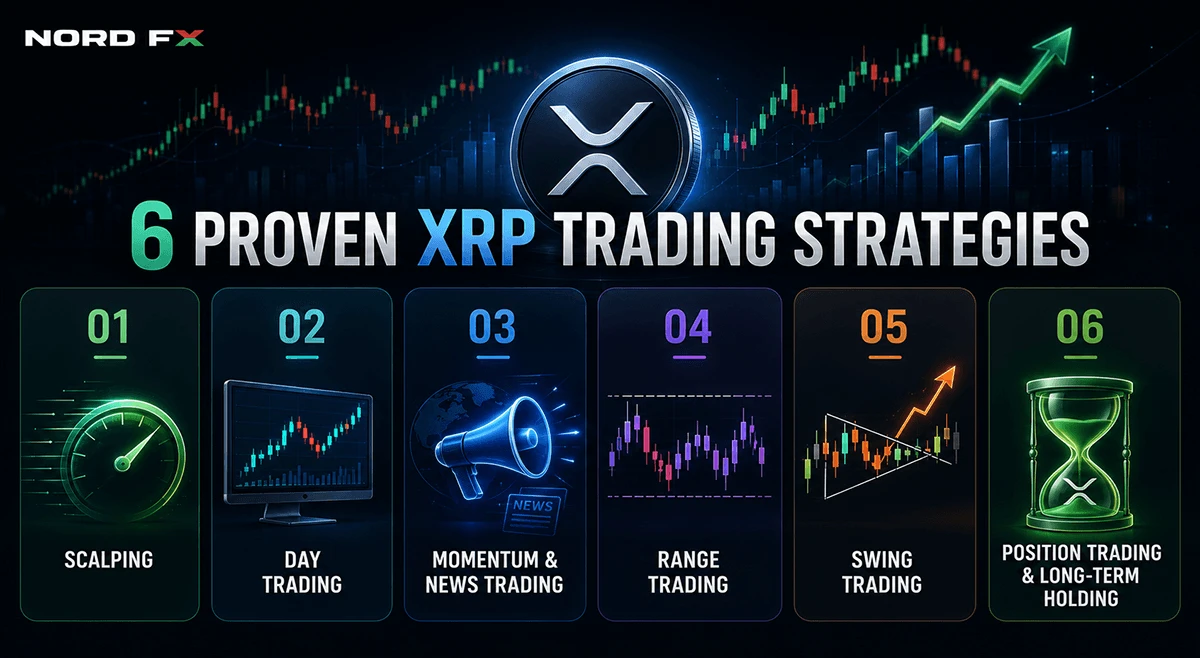
XRP's liquidity and volatility support virtually every trading style. Here are the six approaches most commonly applied to XRP, from fastest to slowest.
1. Scalping
Scalpers make many small trades over minutes, capturing tiny price movements repeatedly throughout the day. XRP's deep liquidity makes it one of the few altcoins where scalping is realistic, because spreads stay tight even in size. Scalping demands fast execution, low fees, full attention and strict discipline — it is the most demanding style on this list.
Suits: full-time traders with low-cost execution. Timeframes: 1–5 minute charts.
2. Day trading
Day traders open and close positions within a single session, avoiding overnight risk and swap fees entirely. A typical XRP day trade targets a 2–5% move identified from intraday support/resistance levels, volume spikes or news momentum.
Suits: active traders with several hours of daily screen time. Timeframes: 5-minute to 1-hour charts.
3. Momentum and news trading
XRP is exceptionally news-sensitive: court rulings have moved it 75% in a day, and ETF launches, partnership announcements and regulatory headlines routinely produce powerful directional moves. Momentum traders enter in the direction of the surge — ideally early, confirmed by volume — and exit when momentum fades. The risk is chasing a move too late; the edge comes from a prepared watchlist of upcoming catalysts.
Suits: traders who follow crypto news in real time. Timeframes: any.
4. Range trading
When no major catalyst is present, XRP often consolidates in well-defined ranges — as it did around the $1.05–$1.25 zone through parts of 2026. Range traders buy near support, sell near resistance, and repeat, placing stops just outside the range. The strategy fails when the range finally breaks, which is why stops are non-negotiable.
Suits: patient, systematic traders. Timeframes: 1-hour to daily charts.
5. Swing trading
Swing traders hold positions for days to weeks, aiming to capture a full directional "swing." Classic XRP swing setups include breakouts from consolidation patterns — triangles, pennants, flags — especially when confirmed by rising volume or bullish RSI divergence. Swing trading fits people with day jobs: analysis happens in the evening, and positions need only occasional monitoring.
Suits: part-time traders. Timeframes: 4-hour to weekly charts.
6. Position trading and long-term holding
Position traders hold for months, trading the macro thesis — ETF adoption, the CLARITY Act, Ripple's institutional roadmap — rather than the daily chart. Many combine a core spot holding with shorter-term CFD trades around it. Dollar-cost averaging (buying fixed amounts at regular intervals) is a common entry technique that removes timing risk.
Suits: investors with multi-month conviction. Timeframes: weekly charts and fundamentals.
For more detailed information please check NordFX Learning Center.
Technical Analysis for XRP Traders
You do not need dozens of indicators — you need a handful you understand deeply.
Support and resistance
The foundation of all XRP analysis. Mark levels where price has repeatedly reversed. On the current XRPUSD chart (mid-June 2026, price near $1.12), the key downside levels are the June low at $1.047 and the psychological $1.00 mark. Overhead, the Fibonacci retracements of the May–June decline define resistance: 23.6% at $1.154, 38.2% at $1.218 and 50% at $1.282 — the last coinciding with the area where the daily 50-period moving average is descending. Only a recovery above the 61.8% level near $1.346 would put the broader downtrend in question.
Trendlines and moving averages
The 4-hour chart shows price testing a descending trendline drawn from the May highs — a classic decision point: a confirmed break and retest opens the way to the fib levels above, while a rejection targets the $1.047 low again. On the daily timeframe, XRPUSD trades below both the 50-day moving average (falling through ~$1.37) and the 200-day moving average (declining near $1.60) — the textbook definition of a downtrend. Price below falling MAs = short bias or patience; trend reversals are confirmed only when price reclaims and holds above these averages, not before.
RSI (Relative Strength Index)
RSI measures momentum on a 0–100 scale. Readings above 70 signal overbought conditions, below 30 oversold. The current picture is instructive: the daily RSI sits around 36 — bearish momentum, approaching but not yet at oversold — while the 4-hour RSI has recovered to ~52 after dipping under 30 at the early-June low. When a lower timeframe resets to neutral inside a higher-timeframe downtrend, it often marks a relief bounce rather than a reversal. Divergences — price making a new low while RSI makes a higher low — are among the most reliable reversal signals in crypto, and traders are watching for exactly that pattern against the $1.047 low.
Volume
Volume validates everything. A breakout above $1.154 resistance on $3 billion+ daily volume is meaningful; the same move on declining volume is suspect. XRP's volume contraction from $3.2 billion in May 2026 to roughly $1.8 billion in June signals a market waiting for its next catalyst.
Chart patterns
XRP respects classical patterns well: descending trendlines and bear flags in downtrends, double bottoms at major support, ascending triangles before breakouts. The current weekly chart — a series of lower highs from $3.66 down to the $1.05 area — is itself the dominant pattern. Trade the confirmed break, not the anticipation.
Fundamental Analysis: Reading XRP Beyond the Chart
Technical analysis tells you when; fundamental analysis tells you why — and for XRP, the why changes fast. Build a simple weekly routine around these sources:
- ETF flow reports. Weekly fund-flow data is now the cleanest read on institutional demand. Sustained inflows have historically preceded XRP outperformance against Bitcoin; sustained outflows warn of distribution.
- Ripple's escrow tracker. Monthly unlocks of up to 1 billion XRP are scheduled and public. Note how much is re-escrowed versus released into circulation — the difference is real supply pressure.
- XRPL network metrics. Transaction counts, active addresses and DEX volume on the ledger indicate organic usage. The 2026 roadmap items — the XLS-66 lending protocol, permissioned markets, tokenized collateral — each have measurable adoption milestones.
- Regulatory calendar. CLARITY Act implementation deadlines, CFTC rulemaking and any SEC commentary remain the highest-impact scheduled events. Ripple CEO Brad Garlinghouse's seat on the CFTC's advisory committee means the company's regulatory positioning is unusually visible.
- RLUSD growth. Ripple's stablecoin passed $1.5 billion in market capitalization and is expanding across Ethereum layer-2 networks. RLUSD adoption deepens XRPL liquidity, which indirectly supports the XRP investment thesis.
A practical habit: keep a one-page "thesis sheet" listing the three bullish and three bearish fundamental factors you consider most important, and update it every Sunday. When the balance shifts, your directional bias should shift with it — before the chart forces you to notice.
A Worked Example: Anatomy of a Disciplined XRP Trade
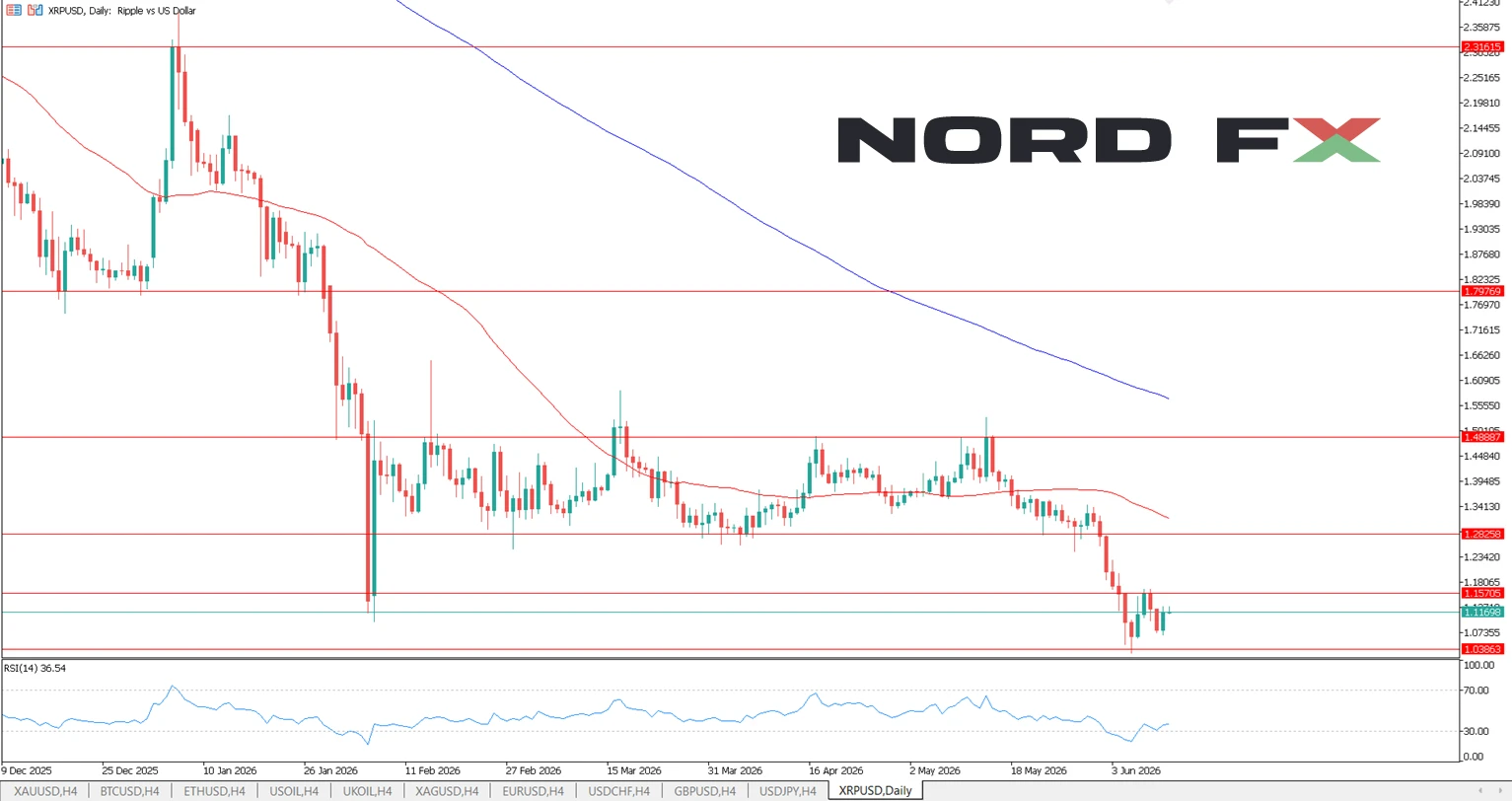
Theory becomes useful only when applied. Look at the daily XRPUSD chart in MT5 (June 2026): price is near $1.12, below the falling 50-day (~$1.34) and 200-day (~$1.58) moving averages, with daily RSI at 36.6. The horizontal levels that have defined this market are clear — support at the June low of $1.039, resistance at $1.157, then $1.283, $1.489, $1.798 and $2.316, each one a former battleground from the December–June decline.
The market sits between $1.039 and $1.157 — a decision zone. A disciplined trader prepares both scenarios in advance and lets the chart choose:
Scenario 1 — Buy: recovery above $1.157
- Trigger. A daily candle closes above the $1.157 resistance on rising volume, ideally with the daily RSI climbing back through 50. Until that close happens, there is no trade.
- Entry and stop. Entry at $1.16. Stop-loss at $1.08, below the bounce structure — a distance of roughly 7%.
- Sizing. With a $5,000 account and 1% risk ($50), position size = $50 / 0.07 ≈ $715 of exposure. At modest leverage, that requires only a fraction of margin.
- Targets. First target $1.283 — the next horizontal level (≈ 1.5:1 reward-to-risk), where the stop moves to breakeven. Second target the $1.489 area, where the falling 50-day moving average converges with resistance (≈ 4:1) for the remainder.
Scenario 2 — Sell: breakdown below $1.039
- Trigger. A daily candle closes below the $1.039 support — confirmation that the downtrend is resuming. One caution: with the daily RSI already at 36, avoid chasing the first red candle; a weak retest of the broken level from below often provides a better entry.
- Entry and stop. Entry at $1.03. Stop-loss at $1.12, back above the broken support and the current consolidation — a distance of roughly 8.7%.
- Sizing. Same rule, same account: $50 / 0.087 ≈ $575 of exposure. Note that the wider stop automatically produces a smaller position — risk stays fixed, size adjusts.
- Targets. First target the psychological $1.00 mark, then $0.94 (≈ 1:1), where the stop moves to breakeven. Second target $0.85 (≈ 2:1) for the remainder.
And if neither close comes — no breakout above $1.157, no breakdown below $1.039 — there is no trade. In a ranging market, the absence of confirmation is itself information, and patience costs nothing.
Notice what makes both scenarios professional: every decision — trigger, entry, stop, size, targets — is defined before any position exists, the risk is capped at 1% in each direction, and the trader does not predict, but reacts. Whether any single trade wins or loses is almost irrelevant; executed consistently with a positive reward-to-risk profile, the process is what generates the result.
The scenarios above are hypothetical examples based on historical chart levels. They are provided for educational purposes only and do not constitute trading advice or a recommendation to open any position.
Risk Management: The Part Most Traders Skip
XRP fell roughly 70% from its 2025 high of $3.66 to its June 2026 low near $1.05. Anyone trading it without strict risk rules eventually gives back their gains. The professional framework:
The 1–2% rule
Never risk more than 1–2% of your account on a single trade. With a $5,000 account and a 1% rule, your maximum loss per trade is $50. If your stop is 5% away from entry, your position size is $1,000 — not $5,000. Position size is calculated from the stop distance, never from confidence.
Always use a stop-loss
Every position, every time, placed at the moment of entry. In a market that can move 10% while you sleep, a mental stop-loss is not a stop-loss.
Respect leverage
Leverage of 1:10 turns a 10% adverse move into a 100% loss of margin. Beginners trading XRP CFDs should start at 1:2–1:5 maximum, increasing only with demonstrated consistency. The leverage that makes a good month spectacular is the same leverage that makes a bad week terminal.
Use a risk-reward minimum
Only take trades offering at least 2:1 reward-to-risk. At 2:1, you stay profitable winning just 40% of your trades. This single filter eliminates most bad trades before they happen.
Keep a trading journal
Record every trade: setup, entry, stop, target, outcome, and what you felt. Review weekly. The journal is how trading mistakes become trading rules.
Practice on a demo account first
Every serious broker offers demo accounts with live prices and virtual money. Trade your strategy on demo until it is profitable across at least 30–50 trades before risking real capital. There is no faster way to lose money than skipping this step.
Trading XRP vs Bitcoin: What Changes and What Doesn't
Many traders come to XRP from Bitcoin, and while the mechanics of how to trade XRP are largely identical — same order types, same platforms, same risk rules — several differences genuinely affect strategy.
Volatility and beta. XRP typically moves further than Bitcoin in both directions. When Bitcoin rallies 5%, XRP can rally 8–12%; when Bitcoin corrects, XRP usually corrects harder. For traders this means smaller position sizes achieve the same risk exposure, and stops must sit wider relative to entry to survive normal noise.
Catalyst structure. Bitcoin's price is driven primarily by macro factors — ETF flows, interest rates, halving cycles. XRP shares the macro backdrop but adds an entire layer of asset-specific catalysts: Ripple's corporate announcements, escrow unlocks, XRPL protocol upgrades and U.S. regulatory milestones. The practical consequence: XRP traders need a fuller event calendar, and XRP offers more frequent idiosyncratic setups that are uncorrelated with the broader market.
Supply mechanics. Bitcoin's supply schedule is algorithmic and immutable. XRP's entire 100 billion supply already exists, with releases governed by Ripple's escrow program. This makes supply-side analysis for XRP about tracking known unlock schedules rather than mining economics — easier in some ways, but dependent on one company's decisions.
Correlation trading. Because the XRP/BTC ratio itself trends, some traders trade the pair directly: long XRP against Bitcoin during periods of altcoin strength and regulatory optimism, and rotating back to Bitcoin when risk appetite fades. Watching the XRP/BTC chart — not just XRP/USD — reveals whether XRP strength is genuine outperformance or just the market tide lifting all boats.
Liquidity profile. Bitcoin remains the deepest crypto market, but XRP's liquidity is more than sufficient for any retail strategy, including scalping. The gap matters mainly for very large position sizes and during extreme events, when altcoin spreads widen faster than Bitcoin's.
The bottom line: skills transfer, but parameters don't. A position-sizing model, stop distance and catalyst calendar calibrated on Bitcoin will misfire on XRP until adjusted for its higher volatility and richer news flow.
Building Your XRP Trading Plan
Everything above is raw material. A trading plan is what turns it into a repeatable business. Yours should fit on one page and answer seven questions:
- Which vehicle? Spot, CFD, futures or ETF — chosen for your goals and jurisdiction, not for maximum leverage.
- Which strategy? Pick one primary style (e.g., swing trading breakouts) and master it before adding a second. Strategy-hopping after every losing trade is the most common failure pattern among new traders.
- Which timeframes? Define your analysis timeframe (e.g., daily), your execution timeframe (e.g., 4-hour) and how often you will check positions. Then stop looking at the chart between those times.
- What is a valid setup? Write down the exact conditions that must be true before you enter — level, pattern, volume, indicator confirmation. If you cannot write it down, you cannot trade it consistently.
- How much risk? Fixed percentage per trade (1–2%), maximum simultaneous positions (2–3 for most retail traders), maximum weekly drawdown after which you stop trading and review (e.g., 5%).
- When do you trade? XRP's most liquid hours overlap with U.S. equity sessions, when ETF flows hit the market. If you trade momentum, those hours are your edge; if you scalp, avoid illiquid weekend hours when spreads widen and thin order books exaggerate moves.
- How do you review? A weekly journal session: every trade graded not on profit but on plan adherence. A losing trade that followed the plan is a good trade; a winning trade that broke the rules is a future disaster rehearsing.
Print the plan. Trade only what is on the page. Revise it monthly — in your review session, never mid-trade.
From demo to live: a graduated path
A sensible progression for a new XRP trader looks like this: four to six weeks on a demo account trading the full plan; then live trading at the smallest possible size for another month, because real money introduces emotions demo cannot simulate; then scaling position size stepwise — only after each stage shows a positive expectancy across at least 20–30 trades. Most traders who blow up skipped a stage. The market charges tuition either way; demo accounts just lower the fee.
Understanding XRP Trading Costs
Profitable trading is as much about controlling costs as picking direction. Every XRP trade carries some combination of the following:
Spread. The difference between the bid and ask price — the universal cost paid on every trade at every venue. XRP's deep liquidity keeps spreads tight on major pairs (XRP/USD, XRP/USDT), but spreads widen during low-liquidity weekend hours and news spikes. Scalpers and day traders, who trade frequently for small targets, should treat the spread as their single most important cost.
Commission. Spot exchanges typically charge 0.1–0.5% per side, often discounted for higher volume or maker orders. Many CFD brokers charge no separate commission, building their cost into the spread instead — always compare the all-in cost, not the headline fee.
Swap/overnight financing. CFD positions held past the daily rollover incur a swap fee, reflecting the cost of leverage. For a multi-week swing trade, swaps meaningfully reduce profit — calculate them into your target before entry, or use spot for long-duration holds where no financing applies.
Funding rates. Perpetual futures charge periodic funding between longs and shorts. In strong uptrends, longs pay shorts — sometimes substantially — which silently erodes leveraged long positions held for weeks.
Withdrawal and network fees. Moving fiat or XRP off a platform costs money, though XRP's own network fee (~$0.0002) is negligible — one reason traders often use XRP itself to move value between exchanges.
A simple cost audit: take your last ten trades and total every spread, commission and swap paid, then compare it to your gross profit. New traders are routinely shocked to find costs consuming 30–50% of gross gains — and that discovery alone usually improves strategy selection more than any indicator.
Common XRP Trading Mistakes to Avoid
- Trading the news after the move. By the time a headline reaches you, algorithms traded it seconds ago. Trade the levels and the reaction, not the headline itself.
- Confusing Ripple with XRP. Positive Ripple company news does not always translate to XRP price gains — the market has repeatedly punished traders who assumed a 1:1 relationship.
- Overtrading a 24/7 market. Crypto never closes, but you must. Define your trading hours and stick to them; fatigue is a position-killer.
- Ignoring escrow and supply mechanics. Ripple's monthly escrow releases are public and scheduled. Being surprised by them is a choice.
- Averaging down without a plan. Adding to losers turned many traders' $3.66 entries into catastrophic positions on the way to $1.12.
- Neglecting fees. Spreads, swaps and withdrawal fees compound. A scalping strategy that wins before fees can lose after them — always calculate net of costs.
FAQ
Is XRP good for beginners to trade?
Yes, with caveats. XRP's high liquidity means fair pricing and easy execution, and the post-2025 regulatory clarity removed its biggest legal risk. However, its volatility demands strict risk management from day one. Beginners should start on a demo account, use small position sizes and avoid high leverage.
How much money do I need to start trading XRP?
Very little. On NordFX, the minimum deposit depends on the account type you choose — check the account comparison page for current requirements. A realistic starting point for active trading is $200–$500 — enough to apply the 1–2% risk rule meaningfully while keeping potential losses trivial. You don't need to trade a whole lot either: fractional exposure is set through your position volume.
Can I short XRP?
Yes. The simplest way is via CFDs or futures, where selling short is identical to buying long. Shorting matters in crypto: XRP's 70% decline from July 2025 to February 2026 was as tradeable as any rally — but only for traders with short-capable instruments.
What is the difference between buying XRP on an exchange and trading XRPUSD on NordFX?
On a crypto exchange, you usually buy on-chain XRP that can be transferred to external wallets, and you profit only when the price rises. On NordFX, you trade XRPUSD as a financial instrument: you can go long or short, use leverage, and avoid wallets and custody entirely, but positions carry overnight fees and leverage risk. Check your withdrawal options in the client area if you need on-chain functionality.
Is XRP trading legal and regulated?
In most jurisdictions, yes. In the United States, the SEC's case against Ripple concluded in August 2025 with retail XRP transactions ruled not to be securities, and in March 2026 the SEC and CFTC jointly classified XRP as a commodity. Rules vary by country, so always confirm local regulations and use a regulated venue.
What hours can I trade XRP?
Spot XRP trades 24 hours a day, 7 days a week. On NordFX you can trade XRPUSD 24/7, with automatic crypto withdrawals 24/7, while XRP ETFs trade only during stock exchange hours. The most active periods typically overlap with U.S. trading hours, when ETF flows and institutional volume peak.
Conclusion: Start Small, Trade the Plan
XRP offers what traders rarely get from a single asset: institutional-grade liquidity, regulatory clarity, scheduled catalysts and genuine volatility. The path to trading it well is unglamorous but proven — choose the vehicle that fits your goals (XRPUSD on NordFX for flexible long/short trading with leverage, spot for on-chain ownership, ETFs for passive exposure), master one or two strategies before adding more, let support, resistance and volume guide your entries, and protect every single trade with a stop-loss and the 1–2% rule.
Start on a demo account, graduate to small live positions, and scale only what works. The XRP market will still be here — 24 hours a day — when you are ready.
Ready to practice? Open a NordFX account, test your XRPUSD strategy on a demo account in MT4 or MT5, and make your first live trade only when your plan proves itself.
Meet the Author
Vanessa Polson is a marketing manager at NordFX with over twelve years of experience in online marketing within the financial services industry. She has developed and executed data-driven campaigns across search, social, and display channels in in-house environments. Her work focuses on translating complex financial products and trading tools into clear, practical educational content, giving her a broad and well-rounded view of the global trading landscape.
Connect with Vanessa on LinkedIn - https://www.linkedin.com/in/vanessa-polson-b17b58127/
Risk warning: Cryptocurrency trading carries a high level of risk and may not be suitable for all investors. Past performance is not indicative of future results. Never trade with money you cannot afford to lose.
กลับ กลับ