Last updated: August 4, 2026
What Is EUR/USD and Why Is It the Most Traded Currency Pair?
EUR/USD shows how many US dollars are required to buy one euro. It is the world’s most traded currency pair because it combines two major global currencies, deep liquidity, high trading volume and frequent economic data from the United States and the eurozone.
The foreign exchange market, or forex, is the world’s largest financial market. Among the many currency pairs traded daily, EUR/USD leads in terms of trading volume and liquidity. Often considered the “king” of forex trading, this pair represents the economic powerhouse of Europe versus the might of the United States.
Whether you're new to trading or simply curious about how global currencies interact, understanding EUR/USD is a great place to start. In this article, we’ll break down what the EUR/USD pair is, why it matters, what drives its price, and how you can trade it effectively.
What is EUR/USD?
At its core, EUR/USD is a currency pair that tells you how many U.S. dollars (USD) are needed to buy one euro (EUR). For example, if the pair is trading at 1.10, it means 1 euro equals 1.10 U.S. dollars.
In forex terms:
- EUR is the base currency (the first one listed),
- USD is the quote currency (the second one listed).
So, when you buy EUR/USD on forex, you're essentially buying euros while selling dollars. If the rate rises, the euro has strengthened against the dollar. If the rate falls, the dollar has gained ground against the euro.
The euro was introduced in 1999 and has become the second most held reserve currency in the world, after the U.S. dollar. Together, the euro and the US dollar represent two of the world’s largest and most influential economic regions: the eurozone and the United States.
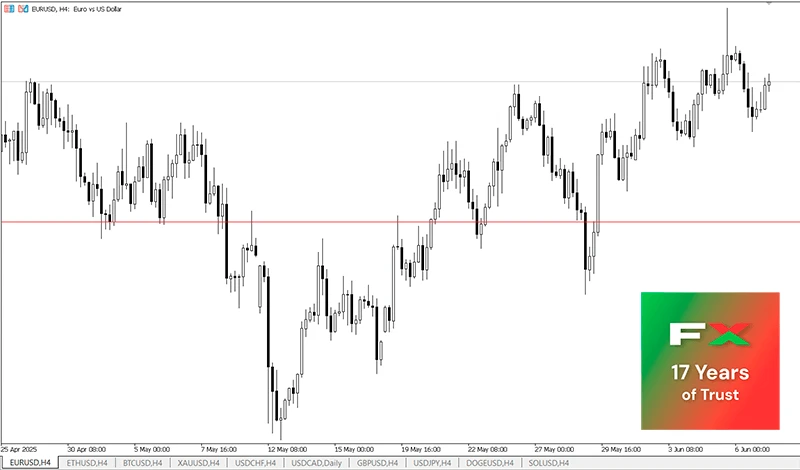
Why EUR/USD Is So Popular
EUR/USD is not just the most traded pair — it’s the benchmark for the entire forex market. Here’s why it enjoys such massive popularity:
- High Liquidity: Due to its trading volume, EUR/USD has incredibly tight spreads, making it cost-effective to trade.
- Around-the-Clock Availability: It’s active throughout all major forex trading sessions — London, New York, and even parts of Asia.
- Reliable Data Flow: Economic data from the U.S. and the Eurozone is published regularly and transparently, offering traders timely insights.
- Extensive Market Analysis: EUR/USD is widely followed by traders, analysts and financial institutions, making economic research and market commentary readily available.
What Affects the EUR/USD Rate?
The value of EUR/USD is constantly in motion, driven by a complex interplay of economic, political, and market forces. Here are the key drivers:
Central Bank Policies
The two central banks behind this pair — the European Central Bank (ECB) and the U.S. Federal Reserve (Fed) — have significant influence.
When interest rates rise in the U.S., the dollar typically strengthens, pushing EUR/USD lower. If the ECB raises rates, the euro gains strength, and EUR/USD climbs. Traders watch central bank speeches and decisions closely.
Economic Indicators
Reports such as GDP growth, inflation rates, employment data (like the U.S. Non-Farm Payrolls), and manufacturing activity can move EUR/USD dramatically. Strong data from one region can tilt the balance.
Geopolitical Events
Elections, trade negotiations, and even wars can influence this pair. For example, uncertainty in Europe may weaken the euro, while political gridlock in the U.S. may dampen the dollar.
Market Sentiment
Global risk appetite plays a role too. When investors feel confident, they may favor the euro. In times of fear or uncertainty, the dollar — often seen as a “safe haven” — tends to strengthen.
How to Trade EUR/USD
Trading EUR/USD is accessible to traders of all experience levels. There are multiple ways to do so:
1. Spot Forex Trading
This is the most direct way — you buy or sell the pair via a forex broker. If you think EUR/USD will rise, you go long (buy). If you expect it to drop, you go short (sell).
2. CFDs (Contracts for Difference)
CFDs let you speculate on EUR/USD price movements without owning the actual currencies. They also allow for leverage, meaning you can control larger positions with a smaller deposit — but this increases both potential profits and risks.
3. Going Long or Short
One of the benefits of forex trading is the ability to profit in both rising and falling markets. Long = you expect EUR/USD to rise. Short = you expect it to fall.
4. Risk Management
Use tools like:
- Stop-Loss Orders to limit potential losses,
- Take-Profit Orders to lock in profits,
- Demo Accounts to practice without real risk.
Always trade with a clear plan and avoid overleveraging — even in highly liquid markets like EUR/USD.
Popular Trading Strategies for EUR/USD
While EUR/USD is relatively stable compared to exotic pairs, it offers enough volatility to attract traders using different strategies:
1. Trend Following
Use moving averages to identify whether the pair is in an uptrend or downtrend. Traders may enter trades in the direction of the trend and ride the momentum.
2. Range Trading
If the price stays within a defined support and resistance zone, traders may look to “buy low, sell high.” EUR/USD often consolidates before big news releases.
3. News-Based Trading
Major news from the Fed or ECB — such as interest rate decisions or inflation data — can cause significant movement. Traders watch the economic calendar to time their trades.
Fun Facts and Trivia
- Nickname: EUR/USD is nicknamed “Fiber”, a nod to the U.S. dollar’s nickname “Greenback” and the fiber-optic cables used for trading.
- Dominance: According to the 2025 BIS Triennial Survey, EUR/USD accounted for approximately 21% of global foreign exchange turnover.
- Parity Moment: In rare moments, the pair has hit parity, meaning 1 euro = 1 dollar — a psychological level that fascinates traders.
- Introduced in 1999: When the euro launched, it traded around 1.17 against the dollar, dipped below 0.85 in the early 2000s, and has seen multiple cycles since.
Conclusion
EUR/USD is the world’s most actively traded currency pair and an important benchmark for the global forex market. Its price is influenced by monetary policy, economic indicators, geopolitical developments and changes in market sentiment.
Its deep liquidity and extensive market coverage make it popular with both new and experienced traders. However, EUR/USD can still experience substantial volatility, particularly around major economic announcements. Traders should therefore use appropriate risk management and understand how leverage can affect both potential profits and losses.
Frequently Asked Questions
What does EUR/USD mean?
EUR/USD shows how many US dollars are required to buy one euro. The euro is the base currency, while the US dollar is the quote currency.
Why is EUR/USD the most traded currency pair?
EUR/USD combines two major global currencies and benefits from deep liquidity, high trading volume, extensive market coverage and regular economic data from the United States and the eurozone.
What causes EUR/USD to rise or fall?
EUR/USD is influenced by Federal Reserve and European Central Bank policies, interest-rate expectations, inflation, employment data, economic growth, geopolitical events and overall market sentiment.
What does it mean to buy EUR/USD?
Buying EUR/USD means taking a position based on the expectation that the euro will strengthen against the US dollar. Selling the pair means expecting the euro to weaken against the dollar.
Can beginners trade EUR/USD?
EUR/USD is commonly traded by beginners because it generally offers high liquidity and relatively tight spreads. However, beginners should first understand leverage, position sizing and risk management and may benefit from practising with a demo account.
When is EUR/USD most active?
EUR/USD is generally most active during the European and US trading sessions, particularly when the London and New York sessions overlap.
Go Back Go Back