Why is gold valuable?
The short answer is that gold combines natural scarcity with unusual physical properties, thousands of years of monetary acceptance, deep global liquidity, diverse demand and independence from any single issuer. Few other materials combine all of these characteristics at the same time.
Gold does not have value simply because people think it looks attractive. Why is gold valuable can be explained through a chain of reinforcing factors: limited supply makes it scarce, durability allows wealth to be stored, history created widespread acceptance, and modern markets, jewellery buyers, investors and central banks continue to create demand.
Key takeaways:
- Gold is naturally scarce, and increasing mine supply is slow and expensive.
- Its durability, divisibility and resistance to corrosion make it unusually suitable for storing value.
- Centuries of monetary use created global recognition that still matters even without a gold standard.
- Jewellery, technology, investment and central-bank demand give gold several independent sources of demand.
- Gold is not another party's financial obligation, although its market price can still rise or fall substantially.
What Makes Gold Valuable?
Gold is valuable because it combines scarcity, usefulness and widespread acceptance. Rarity alone is not enough: a material also needs properties and demand that make people willing to exchange other goods, currencies or assets for it.
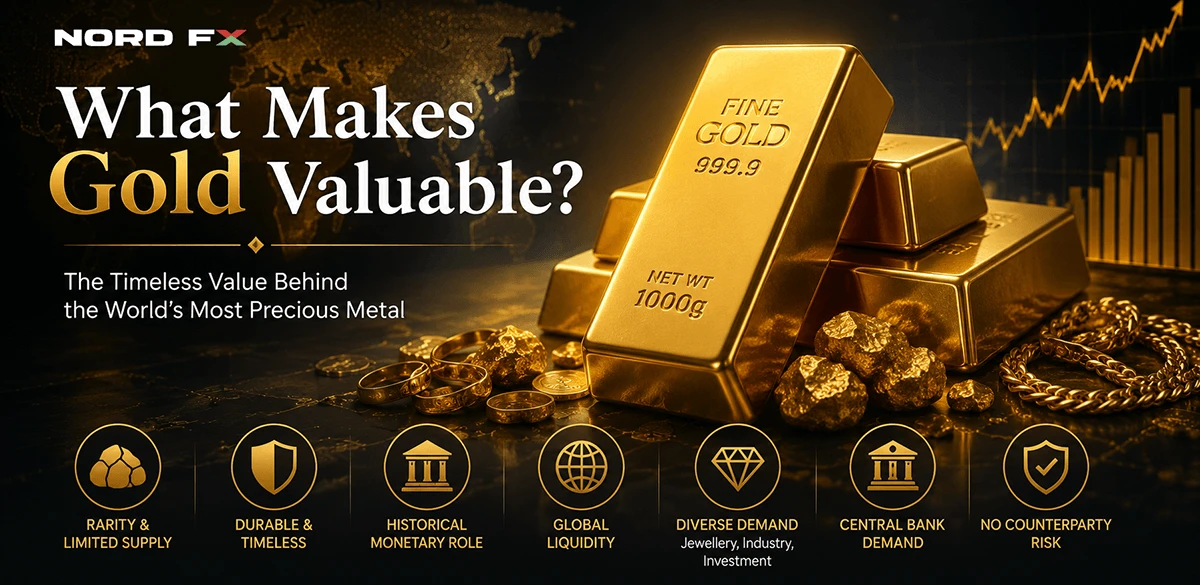
That distinction is central to understanding gold. A substance can be extremely rare and still have little economic value if there is no practical use or market for it. Gold developed value because its scarcity is combined with durability, recognisability, portability and a long history of being accepted across different societies.
The modern gold market adds another layer. Gold can be bought and sold through physical bullion markets, futures markets, exchanges and other financial channels around the world. The World Gold Council estimates that overall gold trading volumes averaged approximately $361 billion per day in 2025, illustrating the scale of its global market.
The basic pricing logic can be summarised as follows:
Source of value | Why it matters | What it does not mean |
Scarcity | Supply cannot be expanded quickly | Gold must always rise in price |
Physical properties | Gold can survive and be stored for long periods | Industrial usefulness alone determines its price |
Monetary history | Centuries of acceptance created trust and recognition | Modern currencies must be backed by gold |
Global liquidity | Buyers and sellers exist across many markets | Gold cannot experience volatility |
Jewellery and technology | Creates non-monetary demand | Industrial demand dominates the market |
Central-bank ownership | Reinforces gold's role as a reserve asset | Central banks will always be buyers |
No counterparty risk | Physical gold is not another entity's promise to pay | Owning gold has no risks or costs |
This is why the question is better understood as “what supports gold's value?” rather than simply “what makes the gold price go up?”
How Do Rarity and Limited Supply Give Gold Value?
Gold is scarce because economically recoverable deposits are limited and new supply requires exploration, mine development, capital and time. Producers cannot simply manufacture additional gold when demand rises.
That matters because one of the requirements of a durable store of value is difficulty of reproduction. If unlimited amounts of a material could be produced cheaply, additional supply would dilute its scarcity.
Worldwide mine production reached about 3,672 tonnes in 2025, only slightly above the previous year. Recycled gold added roughly another 1,404 tonnes to supply. These figures illustrate an important feature of gold: higher prices can encourage additional mining and recycling, but supply does not instantly multiply.
Gold also differs from many commodities because most of the gold mined historically has not been consumed in the same way as oil, natural gas or agricultural products. Because gold resists corrosion, large quantities remain above ground in jewellery, bars, coins, reserves and other forms.
This creates an unusual market structure. Gold is scarce in terms of new production, but there is also a substantial accumulated stock that can return to the market when owners decide to sell.
Scarcity therefore supports value, but scarcity by itself does not determine the price. Demand must exist for the available stock and new supply.
Why Do Gold's Physical Properties Matter?
Gold's physical characteristics helped make it useful as both an object of wealth and a monetary material. It is dense, highly malleable, ductile, conductive and exceptionally resistant to chemical deterioration. The Royal Society of Chemistry describes gold as less reactive than silver and the most malleable and ductile known metal.
Durability is especially important.
A piece of gold can remain physically recognisable for generations without rusting away. That made it suitable for jewellery, coins, ceremonial objects and stores of wealth long before modern financial systems existed.
Gold can also be divided into standardised weights and refined to known levels of purity. These qualities made it easier to measure and exchange than many other scarce materials.
Its distinctive colour and density helped with recognition, while its malleability allowed early societies to create coins and jewellery without advanced industrial machinery.
Modern industrial applications add another source of demand. Gold's conductivity and corrosion resistance make it useful in electronics and specialised technologies. Technology demand accounted for roughly 323 tonnes in 2025.
Industrial demand is therefore part of gold's value, but it is not the primary explanation for why an ounce of gold commands a high monetary value. Its monetary, jewellery and investment roles are much larger.
Why Is Gold So Valuable to Humans Historically?
Gold became valuable to humans because its physical properties made it suitable for wealth storage, while repeated social acceptance turned that usefulness into a monetary convention.
For centuries, gold coins and bullion were used directly as money or as the foundation of monetary systems. Eventually, formal gold standards connected paper currencies to specified quantities of gold.
Under the Bretton Woods system after World War II, international currencies were linked to the US dollar, while the dollar itself was convertible into gold at $35 per ounce. The United States ended dollar convertibility into gold in August 1971, helping bring the Bretton Woods monetary structure to an end.
This history matters because monetary acceptance can become self-reinforcing.
A merchant accepts gold partly because another person is likely to recognise it. A bank can hold it because a market exists for it. A central bank can treat it as a reserve asset because other institutions and markets recognise the same asset.
Over centuries, this network of acceptance expanded across countries and cultures.
Gold therefore gained something industrial metals usually lack: monetary familiarity. That historical recognition did not disappear when governments stopped linking their currencies directly to gold.
How Do Global Liquidity and Demand Support Gold's Value?
Gold maintains value partly because there is a large international market for it. Liquidity means an asset can generally be exchanged for money without needing to find one highly specialised buyer.
Gold trades through major financial centres and physical markets across different time zones. The London over-the-counter market has historically been a major centre of international gold trading, alongside futures exchanges and regional physical markets.
This global market makes gold more useful than an equally rare material with few buyers.
Jewellery demand
Jewellery remains one of the largest physical uses of gold. In 2025, jewellery fabrication accounted for approximately 1,638 tonnes of demand. Although the volume declined as prices rose, the value of global jewellery demand reached a record $172 billion.
Jewellery is important because it combines aesthetic demand with wealth storage. In many markets, gold jewellery is valued both for design and for the metal it contains.
Industrial demand
Technology accounted for around 323 tonnes of gold demand in 2025, including electronics and other industrial uses.
This demand is smaller than jewellery or investment demand, but it reinforces gold's utility. Gold is not valuable solely because it has historically been treated as money.
Central-bank demand
Central banks are another important source of demand. They purchased approximately 863 tonnes of gold in 2025, following more than 1,000 tonnes in 2024.
Central banks can hold gold as part of their foreign reserve portfolios alongside currencies and government securities. The IMF continues to classify monetary gold as a reserve asset.
Their participation matters because it demonstrates that gold still performs a monetary function at the institutional level, even though ordinary currencies are no longer redeemable for a fixed amount of gold.
Why Does Gold's Lack of Counterparty Risk Matter?
Physical gold has no counterparty risk because it is not someone else's promise to repay money. An ounce of bullion does not depend on a company generating profits, a borrower making repayments or a government redeeming a bond at maturity.
The IMF describes gold as carrying no credit risk, although it also stresses that gold can be volatile and should not be treated as risk-free.
This distinction is important.
A bank deposit is simultaneously an asset for the depositor and a liability for the bank. A bond represents money owed by an issuer. A company share represents a claim connected to a business.
Physical gold is different. The metal itself is the asset.
That does not remove every risk. Physical gold can involve storage, insurance, theft risk and transaction costs. Gold prices also fluctuate, sometimes significantly. Financial products linked to gold can introduce their own issuer, custody or structural risks.
“No counterparty risk” therefore explains one characteristic of physical gold. It does not mean “no risk.”
Why Does Gold Still Have Value After the Gold Standard Ended?
Gold still has value because the gold standard was only one mechanism through which gold's monetary role was expressed. Ending currency convertibility did not eliminate gold's scarcity, physical qualities, market infrastructure, jewellery demand or institutional ownership.
Modern currencies derive their monetary status from governments and financial systems rather than promises to exchange banknotes for fixed amounts of gold.
Gold consequently does not need to back a currency to have a market value.
Its role changed instead.
Today gold functions as a globally traded commodity, jewellery material, technological input, investment asset and central-bank reserve. The end of Bretton Woods removed the fixed conversion between dollars and gold, but it allowed gold's dollar price to be determined in the market.
The persistence of central-bank reserves is particularly relevant. Gold remains on official balance sheets decades after fixed gold convertibility disappeared. The IMF notes that many central banks continue to hold gold even though it is no longer the international monetary standard.
That helps explain the apparent contradiction: gold is no longer the foundation of most currencies, yet it continues to possess monetary characteristics.
Why Is Gold More Valuable Than Silver?
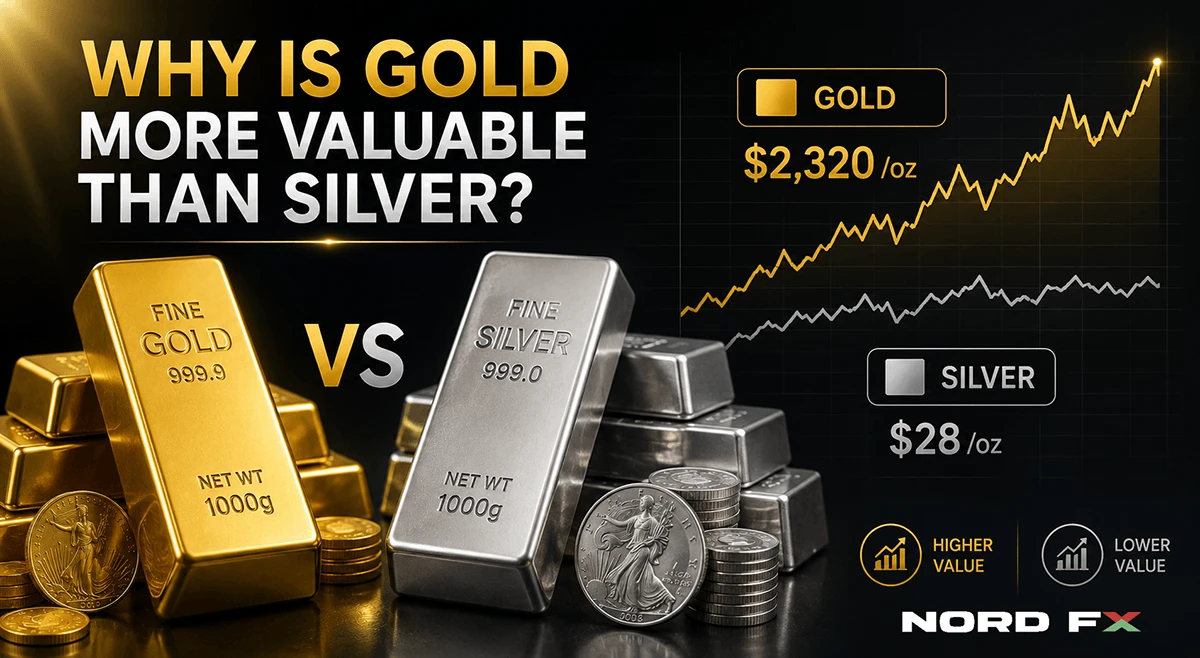
Gold is generally more valuable per ounce than silver because its supply-and-demand structure gives it a stronger monetary role, not simply because gold is rarer.
Silver shares several characteristics with gold. It is a precious metal, has a long monetary history and is widely traded. However, silver demand is more closely connected to industrial applications, while gold has a much larger role in institutional reserves and investment markets.
Central banks, for example, hold substantial quantities of gold as reserves but generally do not treat silver the same way.
Gold also has very high value density: a large monetary value can be stored in a relatively small amount of metal. Its extensive bullion infrastructure and historical acceptance reinforce that advantage.
The comparison demonstrates why rarity alone cannot explain price. Some metals are rarer than gold but trade at lower prices because their demand, liquidity and monetary roles are different.
Is Gold a Fit for Every Financial Objective?
Gold fits some financial functions better than others. Its defining strengths are scarcity, durability, liquidity and independence from an issuer, while its main limitation is that the metal itself does not generate cash flow.
For someone evaluating gold conceptually, the key question is what function the asset is expected to perform.
Gold may fit a role where the objective is to hold a scarce, liquid physical asset outside the liabilities of a company or borrower. It is a weaker fit where the primary objective is regular income, because bullion does not pay interest, rent or dividends.
There are also practical costs. Physical ownership may require secure storage and insurance, while buying and selling can involve spreads and fees.
That is why “gold is valuable” and “gold is suitable for every investor” are completely different claims. A valuable asset can still be unsuitable for a particular objective, time horizon or risk tolerance.
Common Objections to Gold's Value
One common objection is that gold has no intrinsic value because it produces no cash flow. It is true that gold does not generate earnings. But cash flow is not the only basis for economic value. Currencies, collectibles and many commodities also derive value from scarcity, usefulness and willingness to exchange.
Another objection is that gold is valuable only because people agree that it is valuable.
There is some truth in the role of collective acceptance, but this is not unique to gold. Money itself relies heavily on broad acceptance. Gold's difference is that this acceptance developed around a naturally scarce material with physical properties that made it unusually suitable for preserving and transferring wealth.
A third objection is that rarer metals should automatically be more expensive.
They are not. Price depends on both supply and demand. A metal can be extraordinarily scarce but have a small, illiquid market. Gold combines scarcity with unusually broad demand and market infrastructure.
FAQs
Why is gold so valuable to humans?
Gold is valuable to humans because it is scarce, durable, recognisable, divisible and difficult to reproduce. These physical characteristics made it suitable for jewellery and money, while centuries of use created widespread social and institutional acceptance. Modern jewellery, investment, technology and central-bank demand continue to support that value.
Why is gold more valuable than silver?
Gold has historically developed a stronger monetary and reserve role than silver and is substantially scarcer in terms of annual mine supply. It also concentrates more value into a smaller physical quantity and has extensive institutional demand. Silver remains valuable, but its market is more strongly influenced by industrial consumption.
What if I invested $1,000 in gold 10 years ago?
A simplified price-only comparison suggests that $1,000 of gold bought around August 2016 would be worth roughly $3,250 by August 14, 2026. Gold was around $1,339 per ounce at the beginning of that approximate 10-year comparison, versus spot gold around $4,351 per ounce on August 14, 2026. The estimate excludes dealer spreads, storage, taxes, fees and inflation, and past performance does not indicate future returns.
What if I invested $10,000 in gold 20 years ago?
Using an August 2006 gold price of approximately $626.90 per ounce and a spot price around $4,351 per ounce on August 14, 2026, a simple price-only calculation gives a value of roughly $69,400. This is an illustrative calculation rather than the return of a specific investment product. Actual results would depend on purchase date, spreads, custody costs, taxes and other expenses.
What metal is 30 times rarer than gold?
Platinum is commonly described as roughly 30 times rarer than gold, including in educational material from the Royal Mint. However, “30 times rarer” should be treated as an approximate comparison rather than a universal scientific ratio because rarity can be measured through crustal abundance, accessible reserves or annual mine production. Platinum's greater scarcity also shows why rarity alone does not determine price.
Does gold need the gold standard to have value?
No. Gold had economic and cultural value before modern gold standards existed, and it continued to trade after dollar convertibility into gold ended in 1971. Its modern value is supported by scarcity, jewellery and technology uses, global trading markets, investment demand and central-bank ownership rather than a legal requirement for currencies to be backed by gold.
Can gold lose value?
Yes. Gold's structural scarcity does not prevent its market price from falling. Changes in demand, investor positioning, currencies, interest rates and broader market conditions can produce substantial price movements.
By John Gordon, Market Analyst at NordFX
Read More:
- How to Trade Gold Step by Step
- Gold vs Other Safe-Haven Assets
- Trading Gold with Small Capital
OPEN AN ACCOUNT AND TRADE GOLD
Go Back Go Back