What do you actually own when you trade a CFD?
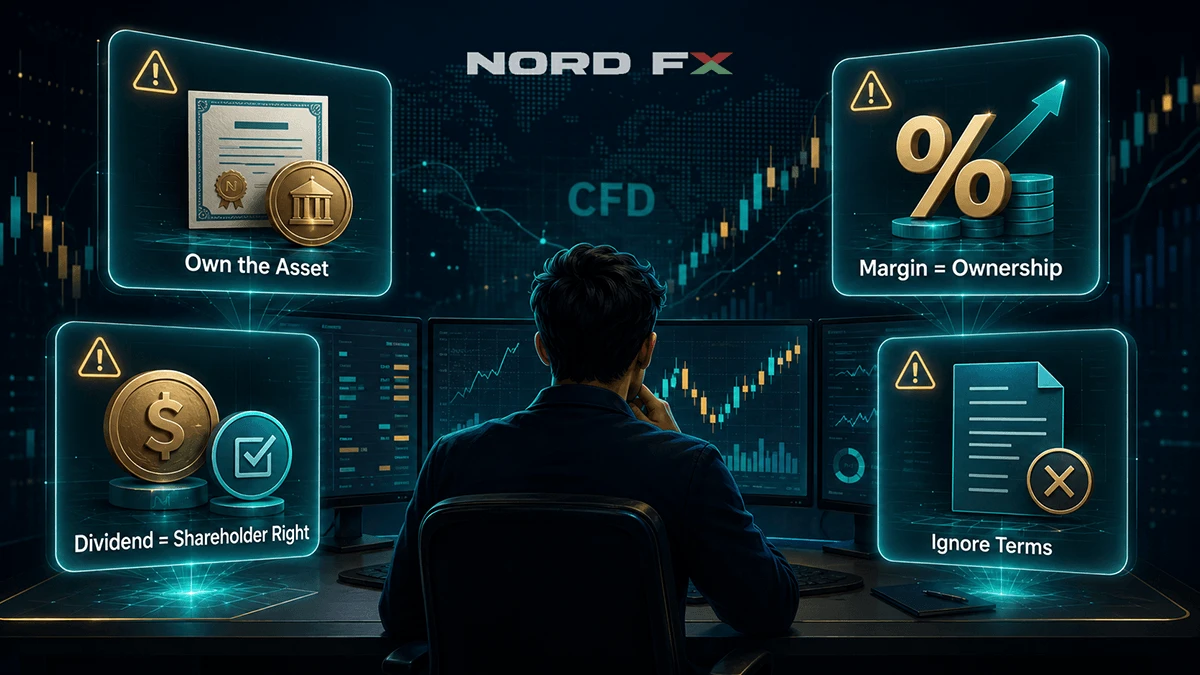
Short answer: When you trade a CFD, you own a contractual position with the CFD provider, not the underlying asset. The contract gives you financial exposure to changes in the asset’s price, but it does not normally provide legal title, delivery rights, shareholder voting rights, or direct ownership of the referenced market.
A contract for difference is designed to reproduce the financial effect of a price movement without transferring the underlying asset to the trader. If the price moves in the direction of the position, the contract may increase in value. If it moves against the position, the contract may lose value.

What Is a CFD Position?
A CFD is a financial contract between a trader and a provider.
The contract references the price of another market, such as:
- a company share;
- a stock index;
- gold or silver;
- oil;
- a currency pair;
- a cryptocurrency.
The trader chooses whether to take a long position, expecting the referenced price to rise, or a short position, expecting it to fall.
When the position is closed, the difference between the opening and closing values is calculated. That difference, after applicable costs and adjustments, is credited to or debited from the trading account.
No purchase of the underlying asset is required for this process. The financial result comes from the contract itself.
What Does the CFD Trader Legally Hold?
The trader legally holds a contractual claim against the CFD provider.
This claim is governed by the provider’s client agreement, product terms, margin rules, pricing methodology, and close-out provisions.
The contract may establish:
- the size of the market exposure;
- the reference price;
- the required margin;
- the applicable spread or commission;
- overnight financing charges;
- dividend-related adjustments;
- how corporate actions are processed;
- when the provider may close the position;
- how the final profit or loss is settled.
The trader does not hold a proprietary claim over the underlying asset. In practical terms, this means the trader owns the CFD position recorded in the account, not the share, coin, metal, currency, or commodity used to calculate its value.
Why Does the Trader Not Own the Underlying Asset?
The purpose of a CFD is to provide price exposure without transferring the asset.
A share purchase enters the securities settlement and custody system. A CFD does not normally do this. The provider opens a derivative position in the client’s account and records changes in its value.
The trader’s order is therefore not usually an order to purchase the underlying asset on an exchange.
For example, opening a CFD linked to 100 company shares does not mean that 100 shares are registered in the trader’s name or placed in a custody account for that trader.
The CFD provider may choose to hedge its own risk by buying shares or using another financial instrument. However, that hedge belongs to the provider. It does not become the property of the CFD client.
The existence of a hedge does not change what the trader owns.
What Do You Not Own When Trading Different CFDs?
The ownership result remains broadly consistent across asset classes.
Share CFDs
A share CFD does not make the trader a shareholder.
The trader does not own equity in the company and is not entered into the company’s shareholder ownership chain.
Cryptocurrency CFDs
A crypto CFD does not give the trader cryptocurrency.
A Bitcoin CFD holder cannot transfer Bitcoin to a private wallet because no Bitcoin was purchased for the client under the CFD contract.
Gold and commodity CFDs
A gold CFD does not give the trader ownership of bullion.
An oil CFD does not give the trader a right to collect physical oil.
The contract is linked to the market price, but physical possession and delivery are not part of the standard CFD structure.
Currency CFDs
A currency CFD does not normally create a withdrawable balance in the purchased currency.
A trader may gain exposure to EUR/USD, for example, without receiving euros that can be transferred or spent outside the trading account.
Index CFDs
A stock index is a calculated benchmark, not a transferable asset.
An index CFD therefore gives exposure only to changes in the index level. The trader owns neither the index nor the shares included in it.
Does a Share CFD Give You Voting Rights?
No.
Voting rights belong to eligible shareholders or beneficial owners of the underlying shares. A CFD trader does not normally hold that ownership interest.
This means the CFD trader cannot usually:
- vote at annual or special shareholder meetings;
- submit voting instructions through a custodian;
- vote on board appointments;
- vote on mergers or corporate reorganisations;
- exercise governance rights attached to the shares.
A CFD may reflect changes in the financial value of a share, but it does not transfer the legal rights attached to share ownership.
Do CFD Traders Receive Dividends?
A CFD trader does not receive a dividend as a shareholder.
However, the provider may apply a dividend adjustment to an open share CFD. For example, NordFX does.
If a long position is open when the underlying share trades ex-dividend, the account may receive a positive adjustment. A short position may receive a debit.
The adjustment is designed to reflect the effect that the dividend has on the underlying share price. It is a contractual account entry rather than a shareholder distribution.
This distinction matters because:
- the trader is not recorded as the dividend recipient;
- the payment may be calculated under the provider’s terms;
- withholding or tax treatment may differ;
- the adjustment does not create shareholder status.
The economic effect can resemble a dividend, but the legal basis is different.
What Happens During a Stock Split or Other Corporate Action?
A CFD trader does not participate directly in corporate actions as a shareholder.
Corporate actions can include:
- stock splits;
- reverse splits;
- rights issues;
- bonus issues;
- mergers;
- takeovers;
- spin-offs;
- special dividends.
The provider normally adjusts the CFD position so that the event is reflected in the contract.
For a stock split, the contract quantity and reference price may be changed. For a cash event, the account may receive a credit or debit. For a merger or takeover, the provider may modify, replace, or close the position according to the contract terms.
The provider’s objective is generally to preserve an appropriate financial result. However, the CFD trader is not receiving new shares or exercising corporate rights.
The position remains a contract before and after the adjustment.
What Happens When the CFD Is Closed?
When the position is closed, no underlying asset is delivered.
The provider calculates the final result using the difference between the opening and closing prices, together with applicable costs and adjustments.
The account may reflect:
- price profit or loss;
- spread;
- commission;
- overnight financing;
- dividend adjustments;
- corporate-action adjustments;
- conversion charges where relevant.
The final amount is settled in cash within the trading account.
The trader does not sell or transfer an underlying share, coin, commodity, or currency. The trader terminates the derivative contract.
CFD Position vs Direct Ownership
Question | CFD position | Direct asset ownership |
What does the person legally hold? | A derivative contract with the provider | The asset or a recognised ownership interest |
Is the underlying asset purchased for the client? | No | Yes, in a genuine purchase |
Can the asset be transferred? | No | Often yes |
Are shareholder voting rights available? | No | Usually available for eligible shares |
Are actual dividends received? | No; adjustments may apply | Yes, for eligible shareholders |
Is physical delivery available? | Normally no | May be available for deliverable assets |
How are corporate actions handled? | Contract or account adjustments | Through the ownership and custody chain |
What does margin represent? | Collateral for the contract | Borrowing support if the asset is bought on margin |
What happens at closure? | Cash settlement of the contract | Sale or transfer of the asset |
Main legal exposure | Claim against the CFD provider | Ownership plus custody and intermediary exposure |
Practical Example: Trading a Share CFD
Assume a company’s shares are trading at $100.
A trader opens a long CFD equivalent to 100 shares. The notional market exposure is therefore $10,000.
If the margin requirement is 20%, the trader deposits $2,000.
What does the trader own?
The trader owns a CFD position with $10,000 of referenced exposure. The trader does not own 100 shares and does not own a 20% interest in those shares.
If the price rises to $105, the gross price change is:
$5 × 100 = $500
The trader has a contractual gain of $500 before costs.
If the company pays a dividend while the CFD is open, the provider may apply a dividend adjustment. If the company completes a stock split, the provider may alter the contract quantity and price.
At no stage does the trader become a shareholder.
If the position is closed, the result is settled in cash. No shares are sold from the trader’s custody account because no shares were held there.
What Common Mistakes Do Traders Make?
Believing margin buys part of the asset
Margin supports the CFD position. It does not purchase a percentage of the underlying market.
Assuming the provider holds the asset for the client
A provider may hedge, but the hedge normally belongs to the provider. The trader still owns only the contract.
Treating a dividend adjustment as a shareholder dividend
The adjustment is made under the CFD terms. It does not create dividend ownership rights.
Assuming identical profit means identical ownership
A CFD and a directly owned asset can produce similar price gains or losses. Their legal structure remains different.
Ignoring the client agreement
Margin changes, close-out rights, financing, corporate actions, and pricing are governed by the provider’s contract. These terms directly affect the position the trader owns.
Thinking regulation creates asset ownership
Regulation may impose leverage caps, client-money rules, negative balance protection, and risk disclosures. It does not give the CFD holder title to the underlying asset.
What Should You Check Before Trading a CFD?
Before opening a position, check:
- what market the contract references;
- whether the instrument is a CFD;
- the required margin;
- the margin close-out level;
- overnight financing charges;
- dividend-adjustment rules;
- treatment of corporate actions;
- whether the provider may change margin requirements;
- how the contract is priced;
- what happens if the provider becomes insolvent.
These details define the actual legal and financial position.
The name of the underlying market alone does not explain what the trader owns.
Frequently Asked Questions
Do you own anything when trading a CFD?
Yes. You own a contractual position with the CFD provider. You do not normally own the underlying asset.
Do you own shares when trading a share CFD?
No. A share CFD gives price exposure to the shares but does not make the trader a shareholder.
Can you withdraw cryptocurrency from a crypto CFD?
No. A crypto CFD does not involve purchasing cryptocurrency for the trader, so there is no coin balance to withdraw.
Can a CFD trader vote at a shareholder meeting?
No. Shareholder voting rights are not normally attached to a CFD position.
Does the CFD provider own the underlying asset?
It may or may not hedge by purchasing the asset. The provider’s hedging decision does not give the CFD trader ownership of that asset.
What happens to a CFD if the broker fails?
The trader normally has a claim relating to client money, the value of closed positions, and the account balance. The trader cannot request the return of underlying assets that were never owned.
Conclusion
When you trade a CFD, you own a contract.
That contract gives you financial exposure to changes in the price of an underlying market. It does not normally give you the asset itself, legal title, custody rights, voting rights, delivery rights, or direct participation in corporate actions.
The distinction is fundamental. A CFD can reflect the economic movement of a share, cryptocurrency, commodity, currency, or index, but economic exposure is not the same as ownership.
Understanding what the contract contains, how margin works, how adjustments are made, and what happens if the provider fails is therefore essential before opening a CFD position.
By John Gordon, Market Analyst at NordFX
Go Back Go Back